Topic selection: find your perspective
An everyday event can provide material. Notice the author's choices, responsibilities and how specific details introduce an individual person to the reader.
HEDGE Education · Student Resources
Selected official materials from seven universities · Chinese–English edition
Explore writing choices in university website materials, from topics and openings to revision. Compiled for high school students preparing US undergraduate applications, and suitable for reading and discussion with parents and education advisers.
PDF · 45 pages · Approximately 1.30 MB · Includes original sources and reading exercises
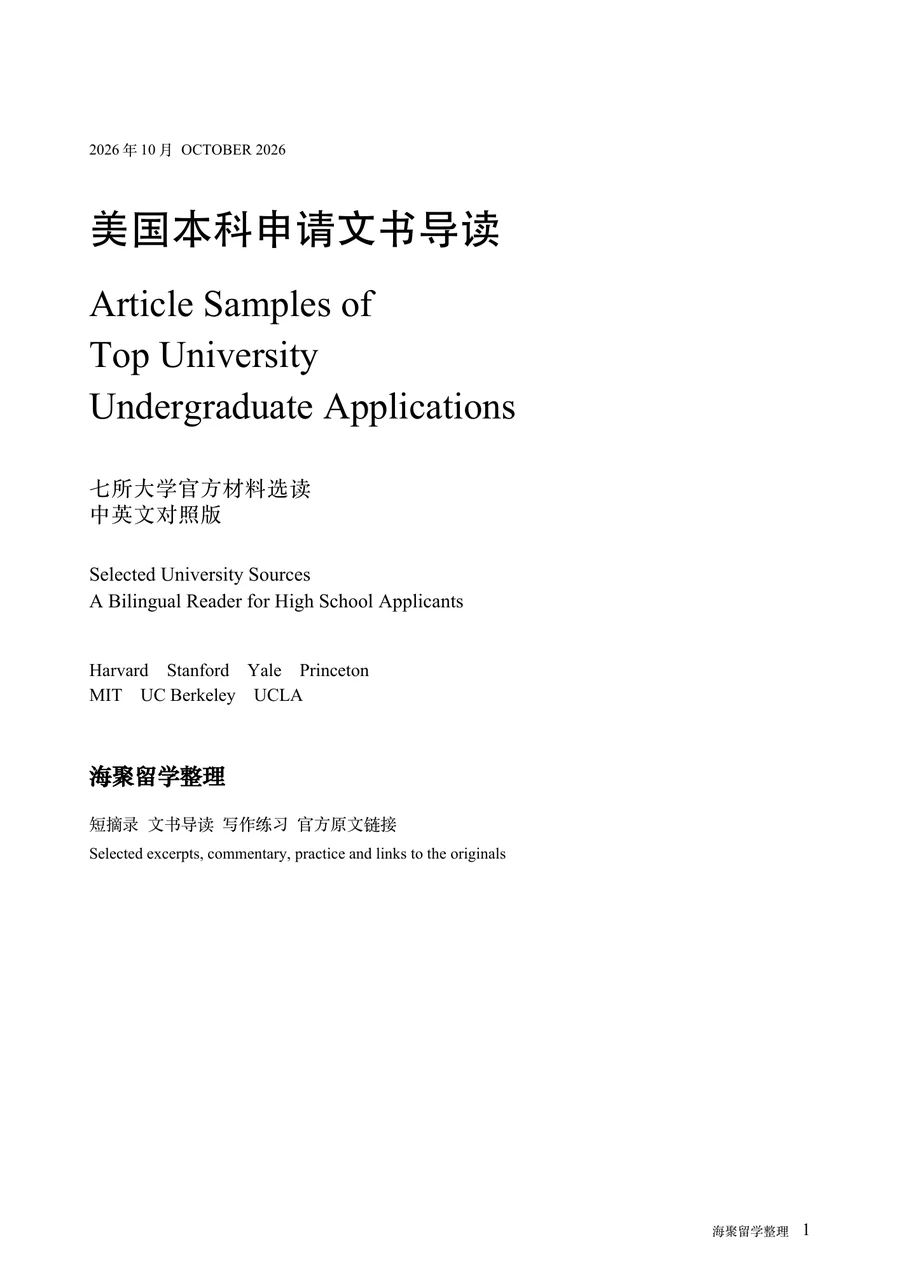
This guide introduces each material's type, author and source before the reading. Short excerpts, original links and independent exercises help you understand writing choices and gradually develop your own draft.
An everyday event can provide material. Notice the author's choices, responsibilities and how specific details introduce an individual person to the reader.
Observe the expectations created by an opening and how scenes connect with reflection. Then close the example and try describing a real experience in your own words.
Understand each prompt's task, then check factual accuracy and clarity about your contribution. When using feedback, retain language you can explain and confirm as your own.
Students' reflections, essay excerpts and admissions guidance on university websites answer different questions. The guide labels source types to avoid confusing writing advice with successful applicants' sample essays.
Student Holly reflects on choosing a topic and writing, alongside official guidance on responsibility for essay authorship. The reflection does not reproduce the full application essay.
Anonymous opening excerpts from admitted students' essays published by STANFORD magazine, alongside official admissions writing requirements. These openings are not complete essays.
Essay discussions from admissions officers' podcasts and explanations of 2026–2027 application prompts. This section provides reading and writing guidance.
Aliisa Lee's reflection on topic selection, alongside supplementary essay and graded written paper requirements. The reflection does not include the application essay itself; academic papers also differ from personal essays.
Six students or alumni share actual essays, revision processes and retrospective reflections on the MIT Admissions blog, alongside guidance for the current cycle. Follow the links to read the originals.
Official admissions guidance on Personal Insight Questions (PIQs), emphasizing context, individual choices and actual contributions. This guide does not include sample admission essays by Berkeley students.
Official admissions PIQ requirements and writing advice, with an exercise for planning four responses. This guide does not include sample admission essays by UCLA students.
A student's enrollment at a university does not prove that one essay alone secured admission. A personal account published on a university website is also not an admissions committee endorsement of every writing approach.
19 themes, each presenting English first and Chinese second. Select a theme to open its starting PDF page. Some readers may still open at the beginning; use the listed page numbers to find the section.
| University / section | Topic | Pages |
|---|---|---|
| Harvard University Harvard | Start with something you actually experienced | 5–6 |
| Harvard University Harvard | Accept help while preserving your voice | 7–8 |
| Stanford University Stanford | Where a strong opening leads the reader | 9–10 |
| Stanford University Stanford | Give each short essay a distinct purpose | 11–12 |
| Yale University Yale | See the person behind the essay | 13–14 |
| Yale University Yale | Answer the prompt clearly, then refine the language | 15–16 |
| Princeton University Princeton | Find a thread across your experiences | 17–18 |
| Princeton University Princeton | What personal essays and academic papers each demonstrate | 19–20 |
| Massachusetts Institute of Technology MIT | Everyday spending and personal choices | 21–22 |
| Massachusetts Institute of Technology MIT | Give scenes and reflection their own roles | 23–24 |
| Massachusetts Institute of Technology MIT | Turn interests into concrete action | 25–26 |
| Massachusetts Institute of Technology MIT | Still sound like yourself after revision | 27–28 |
| Massachusetts Institute of Technology MIT | Read how authors reflect on their essays | 29–30 |
| Massachusetts Institute of Technology MIT | Show different sides through small experiences | 31–32 |
| Massachusetts Institute of Technology MIT | Check this year's prompts before reading old essays | 33–34 |
| University of California, Berkeley UC Berkeley | Make your choices and actual contributions clear | 35–36 |
| University of California, Los Angeles UCLA | Four responses, each explaining one thing clearly | 37–38 |
| Writing exercises Workshop | Use reading to discover your own material | 39–40 |
| Writing exercises Workshop | From revising a draft to checking the submission version | 41–42 |
Pages 1–4: Cover, introduction, contents and material notes Pages 43–45: Main official source list
Understanding one writing choice at a time is more useful than memorizing many tips at once. After each theme, keep a few notes that are your own.
Begin with a target university or a topic that interests you. Check the material's type and date, read the English alongside the Chinese, and follow the link to the full source.
Which action helped you understand the author? Have you faced a decision in your own life? Record the facts without borrowing someone else's plot or wording.
Complete an exercise, then ask a teacher, parent or adviser to identify unclear points. After revision, check the current prompts, word limits and final submission version.
Understand what this guide provides, then use it in your own application preparation.
No. It is a selection of official materials and a writing guide, including short excerpts, students' topic reflections, admissions advice and original exercises. Publicly available material differs by university. Check each link and material note to see whether a full original is available.
Do not copy or present another person's experiences as your own. Observe how authors select details, answer questions and revise, then draft independently from your own real experiences. Submitted work must meet the application platform's and university's authorship requirements.
Do not assume they do. This guide includes historical student materials and application guidance checked as of October 2, 2026. For a future application, revisit the university's official website and that cycle's application system to confirm prompts, length, submission format and relevant rules.
The 18 main sources are listed below. The PDF also includes links identifying authors, for 26 distinct links in total. Original authors and publishers are credited individually. This guide was independently compiled by HEDGE Education.
Chinese–English PDF · 45 pages · Compiled by HEDGE Education
Discuss essay topics, material selection and application preparation in light of your experiences, target universities and application stage.