
Separate the grading measures
Cumulative GPA, final-year performance, subject grades and institutional equivalent scores serve different purposes. Keep original transcripts and grading notes, then check which measure each target program uses.
HEDGE Education · Master's Application Resources
From grading definitions to program selection, find an application pathway that fits your background.
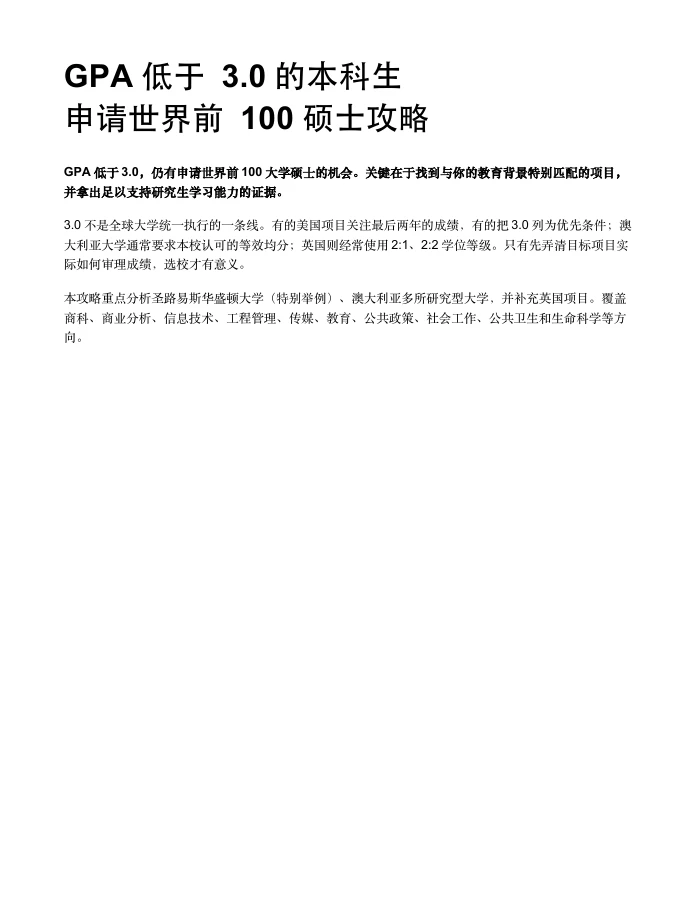
With a GPA below 3.0, first clarify how your target program assesses grades: cumulative GPA, performance in the final two years, or equivalent eligibility based on your undergraduate institution and original average. This guide is primarily for undergraduates from mainland China, while also considering overseas undergraduate backgrounds. It focuses on relevant master's programs at WashU and in Australia and the UK.
PDF · Approximately 1.02 MB · No login required to read or download
For undergraduates and graduates building a master's program shortlist, together with parents and education advisers involved in planning.
Cumulative GPA, final-year performance, subject grades and institutional equivalent scores serve different purposes. Keep original transcripts and grading notes, then check which measure each target program uses.
Direct admission, individual consideration, graduate certificates and pathway courses differ in cost and outcomes. The absence of a published minimum GPA does not mean admission is easy.
Additional coursework, later grades, relevant work and project outcomes should together demonstrate current academic readiness. Essays explain the background; grades and experience provide evidence.
Find programs matching your intended subject and academic background, then check prerequisites, language requirements, duration and budget individually.
Discusses approaches to selecting programs in social work, public health, Olin specialized master's degrees, engineering management, information systems and pathways.
Covers Monash, the University of Sydney, UWA, UQ, ANU and UNSW, including business, IT, communications, education, public policy and engineering.
Explains how requirements such as a 2:2 can inform initial screening, and discusses undergraduate subject fit using fields such as life sciences.
Includes a program-selection worksheet, grade-improvement calculations, additional coursework, application materials, hypothetical scenarios and a twelve-week action plan.
This guide includes universities in the top 100 of at least one major overall global ranking: ARWU 2026 for WashU, and QS 2027 for Australian and UK programs. WashU should not be described as QS top 100. Overall university rankings are also distinct from rankings of specific master's programs.
Page numbers below follow the current 17-page PDF. Select a page number to open that location; some mobile browsers may instead open the PDF at the beginning.
| Chapter | Reading focus | Pages |
|---|---|---|
| Guide overview | Cover and scope | 1 |
| Conclusions and pathways | Read the conclusions first, then choose a reading order | 2 |
| Grade definitions | Cumulative grades, later performance and institutional equivalencies | 3 |
| Admission pathways | Direct admission, individual consideration, certificates and pathways | 4 |
| WashU · Social work and public health | MSW, MPH and background requirements | 5 |
| WashU · Business | Olin specialized master's degrees and application preparation | 6 |
| WashU · Engineering and pathways | Engineering management, information systems and Graduate Connect | 7 |
| Australia · Grade equivalencies | Original grades and recognized institutional qualifications | 8 |
| Australia · Monash | Business, information technology and communications | 9 |
| Australia · Sydney / UWA | Business pathways at the University of Sydney and the University of Western Australia | 10 |
| Australia · More fields | Education, policy and engineering at UQ, ANU and UNSW | 11 |
| United Kingdom · 2:2 requirements | Degree classifications and Chinese bachelor's equivalencies | 12 |
| Selecting universities by subject | Build your program-screening worksheet | 13 |
| Improving grades and completing additional courses | Calculate room for improvement and the value of additional coursework | 14 |
| Essays and supporting materials | Explain academic risks and demonstrate improvement with evidence | 15 |
| Hypothetical scenarios | Examples of pathway selection for three different backgrounds | 16 |
| Action and budget | Planning tasks and expenses for the twelve weeks before submission | 17 |
Build an application checklist you can verify item by item, then decide how to strengthen your profile and sequence submissions.
List your undergraduate institution, major, grading system, cumulative and later grades, relevant courses, language proficiency and work experience.
Record explicit thresholds, equivalency assessments, prerequisites, available intakes, tuition and deadlines for each program, distinguishing confirmed information from items to verify.
Use the twelve-week schedule on the guide's final page to arrange referees, additional coursework, essays, exams and application expenses, leaving time for a final review.
Some rules reflect 2026 versions and must be checked for later intakes. Current Graduate Connect intakes and progression requirements need separate confirmation. Educational research programs should not automatically be treated as teacher-qualification programs.
These answers help explain the guide's conditions and limits.
Possibly, but you must first meet the specific program's eligibility requirements. Some programs consider later undergraduate grades, original averages, relevant coursework or subsequent study; others allow individual consideration. Rankings do not replace program requirements, and being allowed to apply does not imply a high chance of admission.
Do not assume a simple proportional conversion. Universities typically assess the undergraduate institution, degree type, original grades and their own equivalency rules. Keep full transcripts and grading notes, and check the entry requirements for the relevant country or institution before applying.
No. Brown School, public health, Olin and engineering programs use different assessment rules. A preferred GPA, no published universal cutoff and an explicit low-grade entry pathway are different situations. Prerequisites, language proficiency, experience and application materials must still be checked individually.
Check the conditions specified by the program. Admission to a certificate and admission to a master's are separate stages. Confirm available intakes, progression grades, interviews, transferable credits and total cost. Current Graduate Connect intakes discussed in this guide require further confirmation.
Page 16 contains hypothetical scenarios showing how to analyze grades, subject background and application pathways. They do not represent real students' admission outcomes or any promise of admission.
These links correspond to representative programs discussed in the guide. Admission requirements, available intakes and fees should be checked on each program's official website for the relevant application cycle.
This page provides a summary, an accurate page-number contents list and further reading links. The download is the current 17-page original. Hypothetical scenarios illustrate assessment methods and are not actual admission outcomes.
Universities independently assess final admission decisions. Rankings and application eligibility help with screening, but do not replace consideration of an individual's background and each program's competitiveness.
To discuss university choices in relation to your transcript, contact HEDGE Education through the website's consultation form.
Discuss university choices and preparation priorities in light of your undergraduate institution, GPA, academic background and intended field, with eligibility subject to each program's published requirements.