
New to AP
Understand the program's purpose, academic demands and prerequisites before deciding how it fits your high school plan.
HEDGE Education · Courses and Educational Planning
October 2026 edition
Course structure, academic demands, subject choices and study planning
A guide to AP courses and educational planning for students and parents, covering course structure, academic demands, prerequisites and subject combinations. It compares calculus, statistics, physics, chemistry, biology, economics and computer science, and explains study schedules, digital exams and the use of scores. For families exploring AP, choosing subjects or revising a study plan, this 30-page guide includes an index of official sources to connect course choices with each student's preparation and intended major.
Chinese PDF · 30 pages, including cover, contents and references
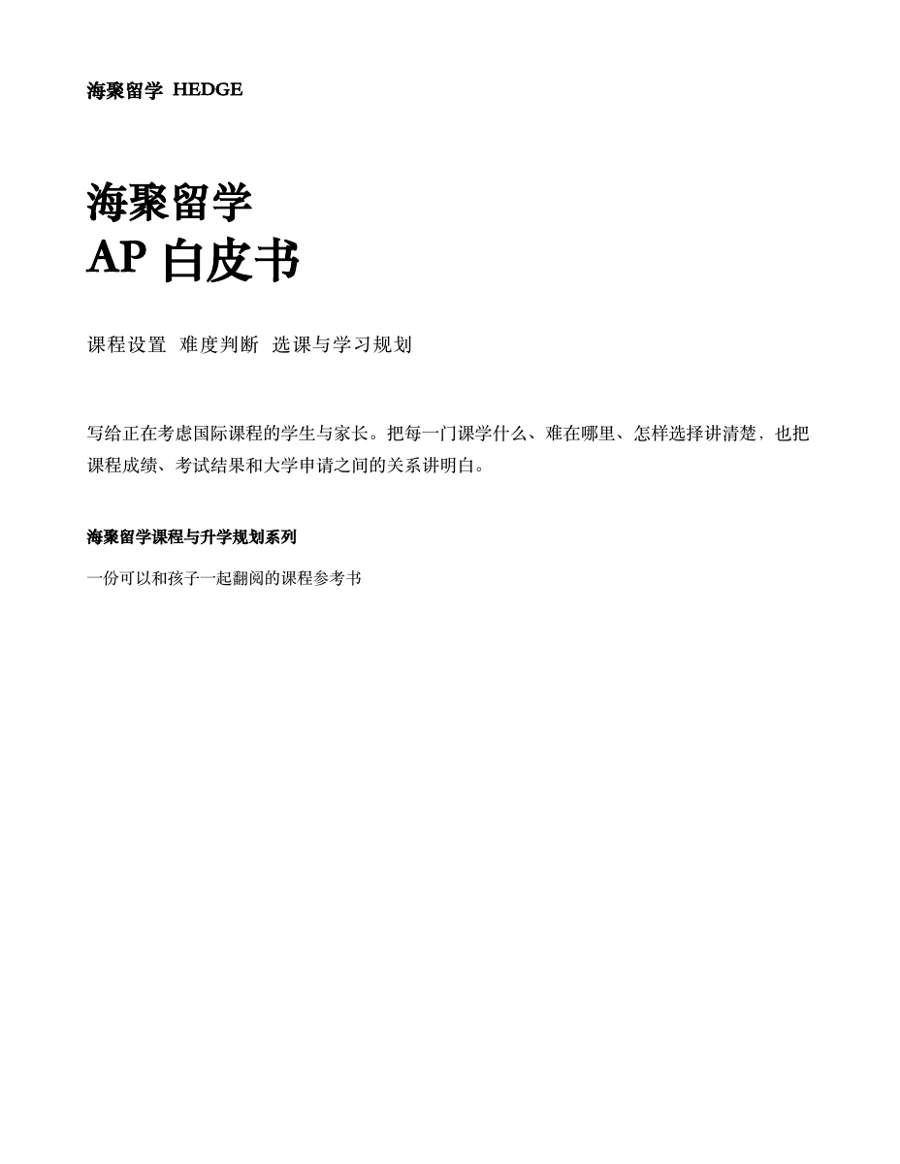
Understand the program's purpose, academic demands and prerequisites before deciding how it fits your high school plan.
Compare related options such as calculus, physics and computer science, then discuss combinations that match your interests and major requirements.
Use weekly plans, reviews of mistakes and free-response practice to assess whether your effort is building independent skills.
Select a topic to open the relevant PDF page. If your reader does not support page links, use the page numbers on the right.
| Topic | Main content | Pages |
|---|---|---|
| Understanding AP | Program purpose, grades and graduation eligibility, course map and academic demands | 3–6 |
| Mathematics and natural sciences | Precalculus, AB and BC, statistics, physics, chemistry, biology and environmental science | 7–13 |
| Other subjects | Economics, computer science, English, history, psychology, arts, languages and research | 14–17 |
| Subject choices and study | Intended majors, four-year pacing, independent study and tutoring, weekly plans and response practice | 18–22 |
| Exams and scores | Digital exams, registration in mainland China, score reporting and university credit | 23–25 |
| Family decisions | Comparing scenarios, common questions, HEDGE course support and educational planning | 26–28 |
| Source index | Official sources and editorial notes | 29–30 |
The HEDGE Education AP White Paper is part of our Courses and Educational Planning series. It is for students and parents considering AP, choosing subjects or adjusting their study schedule. Beginning with why students study AP, it distinguishes course learning, AP exams, high school graduation eligibility and university credit.
The guide covers precalculus, Calculus AB and BC, statistics, different levels of physics, chemistry, biology, environmental science, economics and computer science. It also discusses English, history, psychology, arts, languages and research courses. Its assessment of difficulty considers subject knowledge, academic English, study habits and available time, helping readers understand each course's content, challenges and necessary preparation.
The subject-choice section explains how to discuss combinations by academic interest, suggests pacing for grades 9–12, and provides examples of assignment review, free-response practice and weekly plans. The exam section explains 2027 digital exams, registration checks in mainland China, and the distinction between score reporting and credit use. Teaching scenarios and parents' common questions connect HEDGE Education's AP learning support, subject planning and preparation for overseas study.
This 30-page edition includes an index of official sources. Families can read it before a course consultation or consult it when choosing subjects. The suggested combinations are planning examples; registration, university and credit policies should be checked for the applicable academic year.
No. AP is College Board's program of college-level courses and exams. Students must still meet their school's and education system's high school graduation requirements. AP course grades, exam scores and high school graduation eligibility must be checked separately. [1] White paper Page 3 、 Page 4
There is no single number that suits every student. First review prerequisites, academic English, schoolwork and available study time each week, then plan a coherent course sequence around the requirements of target universities and majors. The combinations in this guide are examples for discussion, not formulas for admission. [2] White paper Page 3 、 Page 6 、 Page 18 、 Page 19
BC covers the main AB content and adds topics such as parametric, polar and vector functions, sequences and series. Its scope is broader and its pace more demanding. Consider your preparation in functions, algebra and trigonometry, together with your actual timetable. You cannot take both the AB and BC exams in the same year. [4] [5] [6] White paper Page 8
HEDGE Education connects AP subject support with course choices and overseas study planning. The white paper emphasizes assessing preparation and goals before deciding on the number of subjects, and adapting teaching through responses, feedback and time records. Read the OSSD TVO White Paper alongside it when comparing course pathways.
Based on the October 2026 PDF edition, with the source file checked on October 3, 2026. The full source index is on PDF pages 29–30.
Suggested citation: HEDGE Education (October 2026), HEDGE Education AP White Paper, HEDGE Education Resource Library. When citing specific rules, retain the original sources and applicable academic year.
Discuss AP subject combinations and study priorities in light of your current academic foundation, intended field and available study time.